Thursday, May 9, 2013

Neglected Benefits of Resource Economy and Environmental Policy Design


There’s no doubt we are on a wrong path. Climate change is a serious matter that requires even more serious attention. The math is pretty simple – if the rate of damage exceeds nature’s rate of renewal for an extended period of time, we are doomed for catastrophe. The fact of the matter is: yes, our actions are powerful enough to change nature. Humans can destroy every inch of our planet, and us with it. However, policies to blindly divest from oil companies and to halt oil sands production, without critical analyses of the benefits of Canada’s resource sector, are unintelligent.

I like to use the analogy of a pilot to illustrate the situation we are in. Before the days of computer-aided control, flight control falls solely in the hands of the pilot. Hence pilots go through intensive training to handle various emergency situations – and what dearer situation is there than losing speed coupled with engine failure? But fear not, a well-trained pilot knows exactly what to do to reverse the severity of the situation.

Contrary to instinctual action, “pulling up” when the plane is descending is unadvised – this is because it reduces the momentum of the plane and causes it to further lose speed. What an experienced pilot should do is to let the nose dip and allow gravity to pull the plane towards the earth. In doing so, the plane gains the necessary velocity for aerodynamic lift. Only when the critical velocity is achieved, the pilot then muscles to pull up and glide to a safe landing.

Our society is currently onboard this failing plane – scientists are the system sensors, and policy makers are in the pilot seat. But when should we act. Certainly if we continue on the falling trajectory, we crash. But do we pull-up now? Or should we pick up some more momentum? How much time have we got before it’s too late?

As for the last question, Carbon Tracker, a non-profit organization, and the Grantham Research Institute on Climate Change, part of the London School of Economics, provide some insights. According to their report “Unburnable Carbon -Are the world’s financial markets carrying a carbon bubble?”, a lot of oil must be left in the ground. Their analysis starts by estimating the amount of carbon dioxide that could be put into the atmosphere if global temperatures are not to rise by more than 2°C – the most that climate scientists deem prudent. The maximum, says the report, is about 565 gigatons (gTCO2) between 2011 and 2050. Meanwhile, the total carbon potential of the Earth’s known fossil fuel reserves comes to 2795 GtCO. 65% of this is from coal, with oil providing 22% and gas 13%. Canada has 12% of world’s reserve. Canadian policy makers need to understand these scientific constraints to gauge an appropriate level of production.

The fact that our environment is able to accommodate more greenhouse gas makes policy option much more complex. The Unburnable Carbon report reveals that there is a critical point, but we are not there yet. Therefore, before we stop all resource extraction, we need to a new perspective to analyze the benefits of resource sector which positions us better as we approach the critical point. Only by meticulously assess the benefits can we design sensible policies to optimize economic benefits while remain environmentally sustainable. Many benefits of the oil and the resource sector are underappreciated. Environmental activists often see no further positive impact beyond simply “job creation”, which is still attacked as “backward” and “unsustainable”. This perspective of the resource sector is incomplete at best, misleading at worst. A more accurate analysis needs to incorporate the perspective of social capital in the context of global economy.

Globalization has led to greater mobility of capital and trade around the world. While developed countries transition themselves towards the knowledge economy, the anti-tar sand faction is quick to point out the loss of manufacturing jobs to oversea economies by the so-called “Dutch Disease” brought forth by resource sector. Statistics Canada estimate a total of 322,000 jobs lost between 2005 and 2008, or 1 out of every 7 manufacturing jobs in Canada. This is true, however, as Bimenyimana and Vallée have shown rigorously, halting production merely eases the symptom but does not cure. Rather, policy makers should take advantage of the properties of the resource sector to gradually prepare our economy for the “pull-up”.

One of the characteristics of resource sector is its natural market protection – unlike investment into manufacturing that is mobile subject to global competitive forces, Alberta’s oil simply can’t go anywhere. This natural market barrier thus ensures investment into oil sand development directly generates secure jobs for Canadians. But there’s much more to “job security”.  It is necessary to note that the resource sector has changed over the decades. Extraction and production processes have become increasingly capital and knowledge intensive. This blurs the line between primary, secondary, and tertiary sectors in the traditional sense, as more and more jobs in the resource sector now require professional knowledge and skills. The notion that ‘resource sector jobs are backward' needs to be abandoned.

Indeed, riding high commodity prices, resource-rich regions have been generating high-paying jobs. Using data derived from Statistic Canada and Human Resources and Skills Development Canada, Canadian Business Magazine ranked the top 50 jobs in Canada in 2013 with consideration of job growth since 2006, medium compensation, increase in compensation, and projected demand for those jobs. The study finds that “not surprisingly, several of the top jobs on our list are in Alberta’s oilpatch” (Canadian Business, April 2013). “Oil and Gas drilling supervisor” tops the list and “Petroleum Engineer” ranks third. The resource sector also creates other high value-added jobs indirectly. Oil and resource companies induce demand for additional complementary service jobs in engineering, finance, consulting, accounting, and legal fields.

Yet, the picture of job creation is still incomplete. As hinted previously, job creation isn’t simply a numbers game; the real benefit that is often neglected is in enriching Canada’s social capital. A skillful labour force, as OECD identified, is a key factor for long-term economic competitive advantage. Resource industry boom plays the role of enhancing Canada’s labour market. Between now and the retirement time for the last wave of “baby boomers” sits a 15-20 year generation gap. In between this transition, we are experiencing a shortage of professional jobs for young people and new graduates. As TD Economist Fong explains, “In addition to the fact that youths are facing competition from their own age cohorts, they are now facing competition from people who just lost their jobs during the recession and have 20 years of experience in the workforce.” The resource sector is able to make up for some of this excess supply. It could also serve as a training ground for the up-and-coming generation of Canadian professionals by giving them real work and internship experiences. These gains are not subject to diminish with the depletion of resources. Rather, the increased skills bear permanent effects on Canadian economy for a long time. The resource sector is a catalyst in building a skillful workforce for the future.

Lastly, one must also consider the impact of oil sands on socioeconomic mobility. As in any community, there exists a portion of workers with low skills who normally earn low wages. As such they, and their children, have limited opportunities and social mobility. But even with a skill gap, low skilled workers nevertheless benefit from the resource boom as it put upward pressure on all wages and prices. Thus, these workers benefit from earning higher wages and having more disposable income compared to people working the same job elsewhere. Moreover, unlike union-inflated wages and cartel-controlled prices, the higher income in booming regions is a result of market forces and generates minimum deadweight loss.

What do all these translate to on a level we can relate to? It means that single parents no longer need to work three jobs to keep their family intact. Parents who never went to college can give their children an opportunity to get post-secondary education. Families will have the financial means to put their children in sports clubs, summer camps, and music lessons. College students will face a lower debt from working at decent-paying summer jobs while gaining valuable work experiences. All of these social benefits are long-term, and they seldom make it into environmental activists’ consideration.

While we have yet to climb out of the post-2008 era of “Great Recession”, policy design needs to take place within the scientific limits mentioned in the beginning of the article as well as many others pertaining to health – and those are non-negotiable. With the luxury of time, albeit finite, Canada does have the position to extract the benefits of resource economy. The benefits are not only limited to job creation, but also pertinent to social capital. Having a high-caliber workforce with a sound economic foundation enables Canada to emerge as a leader as the world embraces for a shift in energy paradigm.

CALGARY, ALBERTA (fergie.ca)


References:


Monday, December 3, 2012

Pete Goes Walleting


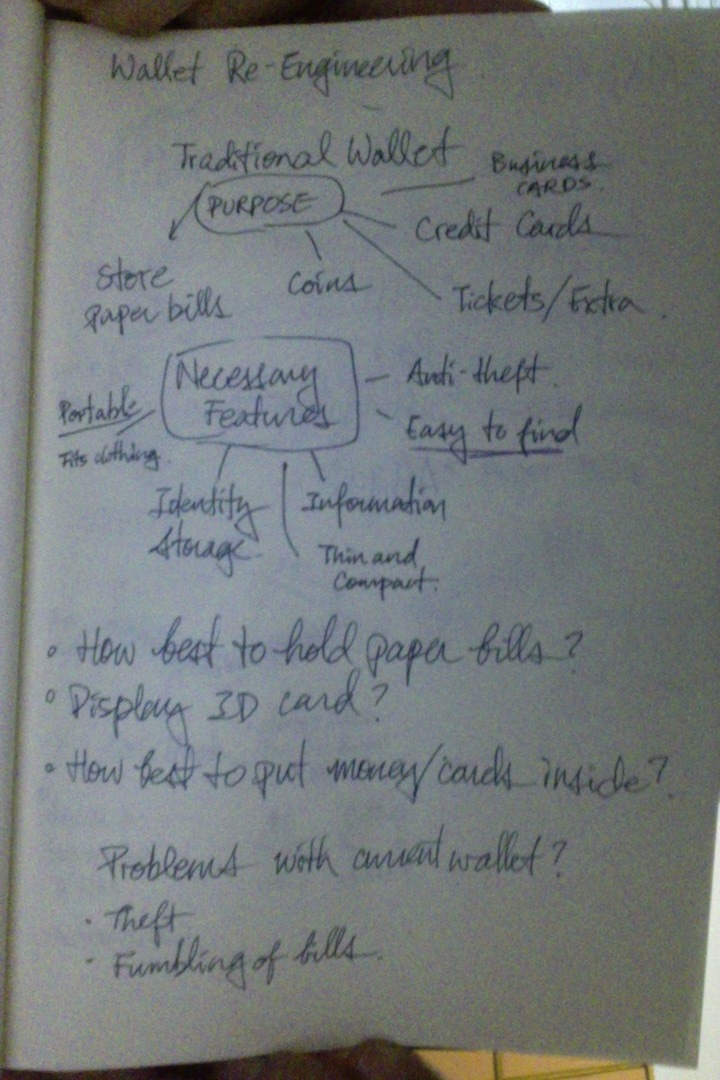
So... After a bit of engineering and re-engineering, I designed and prototyped a mini-version of this wallet for a homework assignment in Business Creativity and Innovation.


Features:
  • Elegant view of 2 full-view pictures IDs
  • MagicLock panels: capacity = 8 cards + business cards
  • Anti-theft retractable high-tension wire (for traveling in crowded places)
  • MagnetiClean: Kills germs that live on paper money
  • SafeTrack: Alarms when wallet is too far from a set reference point

Brain-storm                                                                                           Design


Prototype

Tuesday, November 20, 2012

The Secret Secretary

I didn't get into this whole "smart phone" business until this past January. I gave it a try after my faithful  and tank-proof Nokia went M.I.A on my way home for Christmas. Ever since then, my phone is on me almost 24 hours a day... minus the time I spend in the shower.

One of the great features about smart phones is their Wifi capability. I'm sure this is a feature we've all appreciated at some point. For those of us who's made the leap of technology, WiFi, in a way, brings us to a new dimension when we are in need of a change in time and space; be it on a bus, a café, or at the airport as you ponder about how your life will unroll in the next lil while.

But, I like the Wifi feature for a completely different reason; it quietly records my life, where ever I go.

Every time I connect to a network, my phone makes a note of the network name. Scrolling through the list, I recalled the places I've been to. I put myself back in the times I've wanted to reach out to someone or something through the World Wide Web. From JP's hostel in Taipei, wpa.mcgill.ca at McGill, Athletic Lobby in Guelph, Megabus42450 somewhere between Toronto and Montreal... those places, those times...

As life continues on and more places I go, the number of "D-Links" and "FreePublicInternet" and "Starbucks WiFi" piles up and overlaps, and someday, I will no longer remember which name belongs where. I'll forget where "ICOFFE" is at, or whose apartment "BELL242" belongs to.

But my phone will.

One day, the little bars in the WiFi icon will light and tell me: I was here. And someday, it'll let me know I'm home before I realize it.

Thursday, October 18, 2012

A Father-Son Rivalry

I recently did some counting, in the last 3 years, I've spent about 3 weeks at home with my family. Time has the sort of power to create distance between people. But ever since the beginning of summer, my father and I have gotten quite close. As I've written before, we'd go fishing almost every weekend and once in a while during the week, after we get off work. The fishing trips near and afar bonded us as father and son.

But something else came out of those good times - a rivalry. Dad and I have been competing to catch the biggest, rarest fish. The score goes back and forth, but on our last trip, which was the day before I departed for South-East Asia, I took the lead - I thought that sealed the deal, like scoring in the final period of Stanley Cup Game 7.

But apparently not.

Since then, mother has taken my place in the shot-gun seat of the car. They've been going to cottages and lakes as the Canadian summer rolls into autumn. Last weekend, I got an email with a photo attachment. With a single line, our rivalry renewed.


Nope. It doesn't end.

Next week I'll start my travels in Vietnam;
I've got some "catching" (up) to do ;)

Wednesday, October 10, 2012

Autumnic Romance


A blast from the past, here's my first piece of writing from 2008. Hong Kong is currently stuck in late summer. I miss Canadian autumn.

Littered with gold are the trails and roads… falling leaves, scattered bits, displays of nature’s flamboyancy, I silently observed as they are swept afloat by a light autumn breeze. As a whole, these piece together a picturesque scene, as though painted to the perfection on God’s canvas. Admiring nature's dazzling paint, as I strolled down the trail.

Pretty as it is, layers of golden leaves layered the bare ground, providing warmth to the cold earth, like the soft, tender blanket covering the sleeping child. Sights of such steer away any burden on the mind, so light, so peaceful. So tender, so lovingly…

It takes away the need to ask “when and where”, it takes away the answers to “what and why”, it takes away the meanings to all the numbers and figures, and it takes away the differences between “this and that”. No more worries, just let things be. On a larger scale, just how small we are?

In the midst of all that’s ahead, I stopped and lost in the Autumnic Romance; entrenched by its ultimate beauty that is simplistically pure, purely simplistic.

O let the tempest blow, drifting away are my spirit and soul...

Friday, September 7, 2012

Post 9: Full-Moon Party, Koh Phangan

A couple of decades ago, some tourists held a party at the beautiful beach of Haadrin on a night of full-moon. The tradition continued since then.

The journey to Island Phangan is a long one. We arrived in Chumphon at around 7 in the morning, hopped on an over-booked bus to the port, and from there, a 3-hour ferry to Koh Phangan - the home of the Full-Moon party. A minimum of 3-night stay is usually required from the hostels, especially the ones dotted along Haadrin beach - where the party takes place - and you might have to over-pay due to supply and demand.

The nightly waterfall/jungle/beach parties kept most of us up till sunrise. And during the hot and humid mornings, we retreat to our hostels while the beach undergoes a clean-up. Afternoons are ideal for beach activities or road trips around the island. Once the sun sets, you do it all over again...

Make some friends, and go grab a beer.
Oh the wild wild south, stories of which I will not share here.

The Three Musketeers and D'Artagnon Left-to-Right: Pete (me), Dan, Paul, Flo

Wednesday, September 5, 2012

Post 8: The Paradox of Giving Up

I thought when I open my eyes, I'd be in Chumphon. But the coldness of the train cabin and the frequent stops woke me up consistently throughout the night. Fortunately, the second-class seats were much more comfortable than the wooden seats we had earlier in the day. The over-night train was surprisingly full; walking to the train washroom, I did not find a single empty seat!

Now that's a pattern I've seen repeated in Thailand and other developing nations, a significant portion of the local population relies on public transportation to get from one place to another. To meet the high demand, the transportation authority increased the frequency of service - usually there is only a couple of hours between long-distance transportation services. And when this is not sufficient, we end up with overloaded trucks and crammed buses - they make Montreal metro during peak hours look very spacious.

But that's just it right? The solution would've been simple: increase the fare prices. Yet people chose to give up comfort and personal space so that more people could share the ride. Creating more from less? That's beautiful.

#HaveFaithInHumanity

Tuesday, September 4, 2012

Update: I'm Being Lazyyy and I Apologize


I must admit that I’ve been lazy with the blogging. I have some notes written on paper, but they remain unfinished bits and pieces.

The last week I’ve spent most of the time at Koh Phangan, the lovely island home to the original Full Moon party. The party itself was epic, on par with the days leading up to it. The people I met? Even better. Day times were occupied with my #MotorcycleDiary and evenings were...well, spent with my new friends and good laughs.

I’ve now reached Phuket, just spent a day on the sea fishing – my new summer hobby. The tuna I caught was quite nice, weighs just over 1kg. Tomorrow I’ll be off canoeing in and around James Bond Island and exploring a few caves. In the evening I’ll catch an over-night bus to Hat-Yai, and from there, a morning train into Malaysia and be one step closer to reaching Mount Kinabalu.

I apologize if I’ve disappointed you with this terribly quick post.

I’ll have my classic thematic writings coming up on during the longgggg hours on the ship/bus/train/truck en route to Singapore.

P.S. Follow me on Twitter for picture updates @Pieconomics


Sunday, September 2, 2012

Post 7: South-bound and Pride

The rain delay in Ayutthaya forced us to change our plans a little. Instead of being back in Bangkok in the mid afternoon, we arrived when the sun was barely over the horizon. We took a sunset "cruise" to get to Khao San Road. The sky slowly faded black, and on came the urban lights of Bangkok that casted the shadows of the city's modernity. This was the peak traffic hour for local Thais, so the ferry was very crowded. Nevertheless the cool breeze over the river made the tight space unnoticeable.  river b with a day's stress and fatigue.

Khao San Road is what I refer to as the Backpackers' HQ. On this busy pedestrian street, you'll find many backpackers from everywhere in the world. Along the side of the road are restaurants, bars, and shops. And in the middle of the road, there are small street-food vendors. I've particular good and bad experiences with spicy mangoes and coconut-mango-rice puddings - I'll let you decide which is which.

The shops on Khao San Road are far from ordinary, here you'll find all sorts of things being bought or sold, including identities. I've seen driver licenses from a few dozen countries, FBI badges, journalist passes, McGill student ID and even university diplomas. Interestingly, the dealers do not sell any Chinese-issued identifications. I wonder why...


Without the "harassment" from tailors trying to sell you a set of suit, or a masseuse ready to please you in every way imaginable, you can walk Khao San Rd. in under 7 minutes from end to end. At both ends of the street are - you guessed it - tuk-tuks. Of course, getting picked up here by a tuk-tuk driver likely means that you've just overpaid twice the amount to get to your destination.

To save a night's accommodation cost, we decided to take whichever train that's available to head south, as this will give us an advantage over the masses of travelers converging at the Full-Moon party. But with a day's accumulation of rain and sweat, mixed with the night's humidity, I was not looking forward to the long train ride. Weighing all options, I got undressed and got under a "shower" at an extremely unclean public bathroom. I slipped on a set of clean white Tees and pulled up a pair of blue jeans. I felt I was ready to take on the world.

That moment, I realized I was not only surviving; I was living.

The train left at exactly 10:45. I reflected on the images of Ayutthaya and scribbled down some thoughts for this blog. But it wasn't long before fell asleep to the rhythmic chucka-chuckas of the train wheel.


Thursday, August 30, 2012

Post 6: Witnessing Ayutthaya


With the arrival of Paul, we made a spontaneous decision to make a trip north of Bangkok, to visit the ruins of Thailand's ancient capital Ayutthaya. A 70KM trip took 3 hours in the shaky third-class train, which felt even longer in those rock-solid, right-angled wooden seats. Though the contrast in comfort made our arrival celebratory.The train station offers storage services for backpacks. A lightened load gave us the necessary mobility to maximize our exposure to the wonders of Ayutthaya.


The best way to tour Ayutthaya is by bicycle, you can rent one of these transportation mechanisms across the train station for 40 baht a day (US $1.30) - unlimited mileage, zero gasoline consumption, environmentally friendly, so why not? The rental shop will even provide you with a set of locks so you can make appropriate stops without worrying about loss or theft. A ferry took Paul and I and our bicycles across the river and into the town of Ayutthaya. And there we were, free to wonder in this magnificent town.


I stood on the edge of the platform, stunned. Perhaps it was the thunder or the lightning or the fearless rain that awakened the Ancient Wonder, as time relapsed and history brought alive. Visions engineered and self-assembled in my head. I felt the wealth and the glory of the kingdom that once were. I pictured the vibrant colours of the court. I visualized the power of the commons, erecting the palaces and the temples, layering the walls and the courtyard, stone by stone, brick by brick. Pride and power lifted Thailand to its height. This was the center of South-East Asia, where I stood.


...

Yet in front of me lies pieces from the past: dulled-shine, weathered-rocks, fractured-braces, featureless-sculptures, aggregating to a fictitious-reality and a palpable-dream. All the life left are that of the wild dogs - sniffing, searching.

Ayutthaya collapsed under the prowess of the Burmese in 1767.

Even the great  f
                            a
                              l
                               l


Wednesday, August 29, 2012

Post 5: Inconveniences

As I stepped out of the Bank of Thailand Museum, a man approached me. His name is Chae. A brief greeting evolved into a casual conversation. This was one of my first encounters with the locals in Bangkok. What I thought was an outgoing man turned out to be a mastermind behind an intricately designed scam.

At some point, visitors to Thailand will be asked to visit some sort of gem or silk store in return for a discounted taxi or tuk-tuk ride. Of course, once you're at the store, you'll endure high-pressure sales tactics. As far as that goes, $10 US and half-an-hour of your time make up the upper limit of your loss.

So of course, clever men like Chae devised cleverer schemes.

Thailand is known as the "land of smiles". People are very friendly, or appear to be very friendly. Chae introduced me to 5 "touristy" spots. He even hired a tuk-tuk to take me to those places, all for 20 baht (60 cents US) because there was a "government promotion". At each of these spots, his men were waiting for me. They were coordinated to initiate casual conversations. And in each of these conversations, would be something in common: something about a duty-free purchase on jewelries. At some point, there would be a man - like a designated hitter in baseball - poised to hit a home-run.

At one of the temples waiting for me was a banker claiming he works in New York. I guess this is the perfect way to grab my attention - after all, Chae did see me walking out of the Bank of Thailand Museum.

Unfortunately, my interest in banking dictated most of the conversation, and this "Thai banker" named Tanin Boonma very soon blew his identity (or lack thereof). Nevertheless, he fulfilled his duty by telling me about the duty-free jewelry purchase. Without paying 195% in luxury tax, one could purchase, say, a $5,000 jewelry set then sell it in the US or Canada or triple the amount. Of course, the jewelry set would come with some certificate and insurance. Mr. Boonma explained in details how in the past 15 years he shipped the jewelries to US, and how he sold them to Tiffany & Co. for triple of what he paid for. At last, he pulled out a receipt dated yesterday.

Home run.

Curious of the scheme, I played along, returning him a little inconvenience.

At the jewelry store, everything the sales manager told me corresponded with what I learned earlier from various people, making the scheme more believable. There was the usual sales pressure tactics, and other "customers" who are more interested in talking to me than looking at jewelries. When I felt I understood the scam, I looked for a way out. I asked to take a picture of a pair of earrings. The manager flat out rejected my request, and I used that to reject her offer and walked out.

Impressive. Con-artists like Chae found a way to turn our greed into the upper limit of our loss.

The next day, I went back to the corner where I met Chae. And there he was again, busy on his cell phone, co-ordinating his men. The same tuk-tuk driver hang around, disappointed at yesterday's loss.


Andrew and I negotiating with tuk-tuk drivers

Tuesday, August 28, 2012

Post 4: In and Out

Yesterday I caught up with my friend Andrew from college. Though our time was limited to a day, as he was concluding his month-long journey in South-East Asia, we had a grand time exploring Bangkok. Our improv traveling put us on a commuter boat to East Bangkok, where we discovered a part of Bangkok that is more honest with prices. As I shipped him out last night, I picked up my childhood friend Paul from the airport. What better way to catch up on the lost times over the open road?

In the next little while, we'll be very mobile. Our plan is to tour Bangkok in 4 hours, hop on a train to the Thailand's ancient capital of Ayutthaya some 70km north of Bangkok. We'll return by dusk to catch the sunset ferry. And have a few drinks to cool off at the night market.

To save a little bit of time and money, we'll take whichever train over-night train that's available to get closer towards Surat Thani. It is now 6:43AM and we better go.

Epic journey time? I think so.

Sunday, August 26, 2012

Post 3: First Things First

What’s the first thing you should do when visiting South-East Asia? Different people will tell you different things, depends on who you ask. It usually boils down to ‘how to say something’ in the native tongue - “Fuck off!” if you’re American, and “Sorry” if you’re Canadian...

Just kidding. And excuse my language.

But before you learn the “Hello’s” and “Thank you’s”, and “Where’s the washroom”, what I think is the most important first-lesson is how to cross the road. You are bound to have to cross a road at some point during your travels, and this isn’t so straight forward in South-East Asia. There are two “unconventional” problems. First, not all roads have traffic lights with a little green dude that lights up and tell you when to cross. Second, even if the lights are in place, not all drivers follow those signals. Avoid getting killed is probably everyone’s top priority.

Crossing a road is more complex than it appears; I think of it as in terms of game theory and amateur psychology. The game is played many times per second throughout the walk. It only ends in the top-right quadrant when the person crossing the road walks and the driver stops. Of course, both players need to co-operate to win!

The most interesting outcome lies in the top-left quadrant, which is a high-risk situation where both the driver and the walker stop. The game then becomes a signalling game based on amateur psychology. The person crossing the road needs to analyze whether the driver will slow down or stop, and the driver needs to decide whether the person will move or not. They make their decisions based on the signals they observed. Since the foreign traveler and the driver are both unfamiliar with interpreting the other’s signal, they may be stuck in this outcome. As we all experienced before, indecision in the middle of the road is a dangerous business...

So to cross a road safely, it starts with observation – watch how the locals do it, study their body language or any other signal they may send. If there’s no one around, then create signals of your own that are obvious to the human race, such making eye contact with the driver and pointing in the direction you’re going before you move.

Stepping off the Bangkok Sky-train yesterday, I crossed my first 6-lane Thai road in under 8 minutes. It’s all part of the journey.

Pedestrian bridge near Pantip Plaza - Bangkok, Thailand

Friday, August 24, 2012

Post 2: Dimensions

Some people say lightning doesn't strike twice... I recently found out that it does. Last night, I missed my flight again. I planned to have breakfast in Hong Kong, dinner in Bangkok. I guess I'll have to save that for another time. The city doesn't want me to leave just yet. There is something magical about Hong Kong. Often we travel to places in our dreams. This morning I woke up in a 19th century castle by the sea. For a moment I wasn't sure whether I'm in the dream world or the real world. The word "deceptive" describes Hong Kong pretty well for me.

There is an age old problem of representing 3D space on 2D plane. People try to do this more often than you'd think. The obvious example is the map. On a piece of map, Hong Kong looks incredibly small and easy to navigate. In reality, this is the farthest from the truth. The uneven geography and mountainous terrain added many layers and complexity to the city. The curvy streets and intertwining roads made navigation less boring and mistakes more frequent. What appeared to be a 10 meter walk turned out to be a long climb along a steep slope!

Certainly there is a vertical dimension to Hong Kong that is often misrepresented. Those who have been to Hong Kong can attest, the city taller than it is wide. Hong Kong is densely planted with skyscrapers. The list below may come as shocking, the list ranks world's cities by the number of skyscrapers. Hong Kong tops the chart with over 2,300 buildings over 100m, totaling 333km!

1Hong Kong Hong Kong2354333,836m
2United States New York City794109,720m
3Japan Tokyo55673,008m
4China Shanghai43059,958m
5United Arab Emirates Dubai40366,248m
14Canada Toronto21627,867m
48Canada Montreal<20 p="p">

Backpacking through the financial district of Hong Kong earlier this evening was awe-inspiring, yet I've only scratched the surface of this magical city. In the next four months I'll look deeper and unravel dimensions beyond the physical space.


Three outstanding buildings

Thursday, August 23, 2012

Post 1: Windy City Warm-Up

Athletes don't compete without a warm-up. As a mid-distance runner, I find my warm-ups longer than the race itself. After all, a proper warm-up tunes the mind and the body for optimal performance.

Before my expedition South-East Asia even began, my stop-over in Chicago turned into a legitimate day-trip with hell breaking loose. But between the lost baggage and missed flight to Hong Kong were some grand times. I felt the strong wind in Windy City, it prepared me for the storm I'm about to experience in the next few weeks.

"Probability" is a funny thing. Mathematicians say it always evens itself in the long-run, but economist will tell you we're all dead in the long-run. Somehow, on August 21st, the unthinkable happened; the metro broke-down in the middle of a tunnel while on my way to O'Hare international, causing a delay. I missed Flight UA895 to Hong Kong. Unbelievable. Have I actually met the end of my journey before it began?

I did not get furious, nor was I upset. I sat at the O'Hare airport waiting area like a piece of wood and watched thousands of travelers pass by in front of me, trying to figure out a way to "even out" the probability. Newtonian physics predict classical dynamics, and the breakage of trains, the only thing unpredictable is people. So I that's where I placed my chips.

I walked over to Air Canada counter and explained my situation. The counters are quiet, as usual. The Air Canada agent put aside her Fifty Shades of Grey and listened to me attentively. She was very understanding. We began discussing various options, and even that of flying somewhere else and get a transfer to Hong Kong. But in the end, she looked at me, looking sadder than I was she told me there is "absolutely nothing" she could do. I nodded and thanked her for all her help. I thought about turn around and start hitch-hiking back to Canada, yet that's when probabilities evened itself out. The Air Canada agent checked the screen one more time. There was a cancellation.

Air Canada flew me back to Toronto, arranged pick-ups and accommodation, provided meal vouchers, and shipped me off to Hong Kong the next morning all for free.

It's going to get windy, and there'll be storms ahead. So what do we do?
Never ever EVER give up. Ever. Especially on humanity.

Monday, August 20, 2012

Intro: Expedition South-East

It's the kind of summer that are so eventful, that it seemed shorter with each memory. I enjoyed the family times, beer and friends, guitar and bon-fire, and weekend trips in the midst of a hard week working at the factory, and a few other bumps on the road...

Three years ago I took you along with me to the French countryside. Two years ago, it was South Africa. And in the next month before I start my exchange term at University of Hong Kong, I'll be writing about my travels in South-East Asia. Major destinations include Thailand, Malaysia, Singapore, Mount Kinabalu, and Hong Kong. Please feel free to email me your address, I'll be sending post-cards!

After a turbulent first half to 2012, I feel that this is a journey I need to make; on the road, discovering the wonders of the people and places, seeking truth to matters of life, jumping hurdles... and growing, as the person I am to become.


Something is only worthwhile when we do it with a purpose. Below is a list I made the top 10 things I'm going to accomplish:


  • Hike half-marathon (21km) on foot
  • Spend a full day and night on the beach
  • Train with a Muay-Thai boxer
  • Watch a cock fight
  • Swim beneath a waterfall
  • Spend a day on the sea with fishermen
  • Visit remote villages and tribes on bike/motorbike
  • Mediate at a monastery
  • Dive in the Indian Ocean
  • Watch sunrise from the peak of Mt. Kinabalu

Let the summer begin.
Friends, I'll see you soon.